Inside the Issue
Peer-reviewed research and commentary from the current volume.

Countermeasures by Airport Authorities & Airline Industries
This article examines the multi-layered security architecture adopted by the Airport Authorities to combat evolving threats such as terrorism and drug trafficking. . It traces the development of international legal instruments like the Chicago Convention and the frameworks established by ICAO and IATA, and evaluates how these guidelines are adapted by individual nations and airline operators. Through a comparative analysis of regulatory frameworks in Europe, the United States, India and the United Arab Emirates, the article highlights how international standards intersect with national laws and airline-specific policies. While this tiered structure enhances flexibility and allows airline-specific bans on certain goods, it also reveals the risk of regulatory fragmentation. While affirming the robustness of existing aviation security measures, the article underscores that although harmonised global frameworks are in place, the inconsistency in implementation across jurisdictions and airlines could create gaps exploitable by malicious actors.

Jet-streams & Geopolitics: India’s Rise and the Global Fuel Wars
In an age where global flight paths intersect with geopolitics, aviation fuel has emerged not merely as a commodity—but a currency of power. This article explores how aviation turbine fuel (ATF) has emerged at the heart of the global energy and conflict narrative, shaped by the fallout from the Russia–Ukraine war and the Iran–Israel confrontation. India—home to the world’s third-largest oil imports and one of the fastest-growing aviation markets—has found itself transformed from a passive buyer to a strategic refiner and unsanctioned supplier. Its refining complexes now act as energy conduits between sanctioned states and fuel- hungry markets. This article traces how India’s unique positioning is helping rebalance global aviation supply, while also analyzing the ripple effects of regional wars on aviation costs, airline operations, and SAF (Sustainable Aviation Fuel) diplomacy. From maritime chokeholds to green fuel negotiations, we illustrate how jet fuel has become the new battlefield for economic leverage and energy sovereignty. In a world where every barrel has a political footprint, India’s fuel flows may determine more than flight paths—they may shape the future of global alignment

Beyond Code-Sharing: Unlocking Strategic Aviation Partnerships in India
In an era where global mobility fuels economic growth and cultural integration, the aviation industry must evolve not only through technology, but also through policy innovation. At the heart of this transformation lies a powerful yet often overlooked mechanism: airline Anti-trust Immunity (ATI). Far from undermining competition, ATI, when carefully implemented, has enabled leading economies like the United States, the United Kingdom, and the European Union to foster deep, cross-border airline alliances. These alliances have redefined the passenger experience by expanding global connectivity, optimising routes, and driving operational efficiency. As the demands of international travel continue to rise, ATI stands as a bold example of how strategic regulatory frameworks can unlock unprecedented collaboration in the skies. While code-sharing agreements have been legally recogniaed and functionally present in India's aviation sector for over a decade, their impact has largely remained superficial, due to the lack of ATI to these code-sharing agreements. In contrast to global models where ATI has allowed deep integration of airline alliances, India's aviation landscape remains fragmented, operationally redundant, and commercially inefficient. This article investigates the structural problems impeding meaningful airline cooperation in India, explores the transformative potential of ATI, and explains why India—despite permitting limited coordination—has failed to adopt a fully enabling framework. Finally, the article outlines the regulatory reforms and policy vision needed to future-proof Indian aviation through strategic collaboration.

Regulating the Skies: How Aviation Accidents Shape Safety Policies
This article examines how major aviation accidents involving passenger aircraft have profoundly influenced global safety standards, operational practices, and legal accountability. It focuses on catastrophic events that led to significant industry reforms, highlighting the complex interplay of factors such as technical failures, pilot error, communication breakdowns, and oversight lapses that contribute to such outcomes. The discussion outlines essential safety protocols, both pre-flight and post- flight, that are guided by international frameworks established by organisations like the International Civil Aviation Organisation (ICAO) and enforced by national aviation authorities through their respective annexes and regulations. A core aspect of the article is the intricate process of determining liability after an accident. It explores how fault is assigned, whether it lies with the airline, individual pilots, aircraft manufacturers, or even passengers. Through various case examples, the article demonstrates how legal responsibility is meticulously shaped by both international conventions, such as the Montreal Convention, and specific national laws. This determination often depends on the jurisdiction, the parties involved, and the precise nature of the claims arising from the accident. The ongoing evolution of these frameworks reflects the continuous efforts to enhance aviation safety and ensure accountability across all sectors of the industry.

Fractional Ownership in Aviation: Shared Skies or Fragmented Controls?
As private aviation enters a new era of post- pandemic growth and shifting consumer demands, fractional ownership has emerged as a disruptive force promising access without exclusivity. This article delves into the transformative impact of the fractional ownership model, where multiple stakeholders co-own an aircraft in exchange for proportional usage rights and its evolving role in reshaping the aviation landscape. Born out of the success of pioneers like NetJets, the model has become a hybrid solution that bridges full ownership and charter services, offering flexibility, cost- sharing, and customised access. However, with innovation comes complexity. This study unpacks the multifaceted regulatory, legal, and financial dimensions of fractional ownership. It explores the contrasting global regulatory approaches, with a sharp focus on the FAA’s Subpart K framework and the gaps within ICAO’s guidelines, emphasizing the challenges of operational control, liability distribution, and cross-border governance. The analysis extends to the economic intricacies from acquisition costs to tax structuring questioning whether this model democratizes private aviation or simply repackages it for an elite clientele. India serves as a critical case study, where the absence of a tailored regulatory framework, opaque tax treatment, and cautious financial institutions have constrained market growth. By juxtaposing global practices with India’s legal vacuum, this article highlights the pressing need for coherent policy intervention. Ultimately, the article argues that fractional ownership stands at a crossroads: it has the potential to redefine private aviation access, yet risks perpetuating fragmented regulatory controls unless met with unified legal standards, updated international guidelines, and transparent operational governance.
Aviation Spotlight
We spotlight critical research on antitrust immunity, safety policy evolution, and fuel-war geopolitics defining the new architecture of Indian civil aviation.
Analysis: IndiGo Flight Cancellation Case
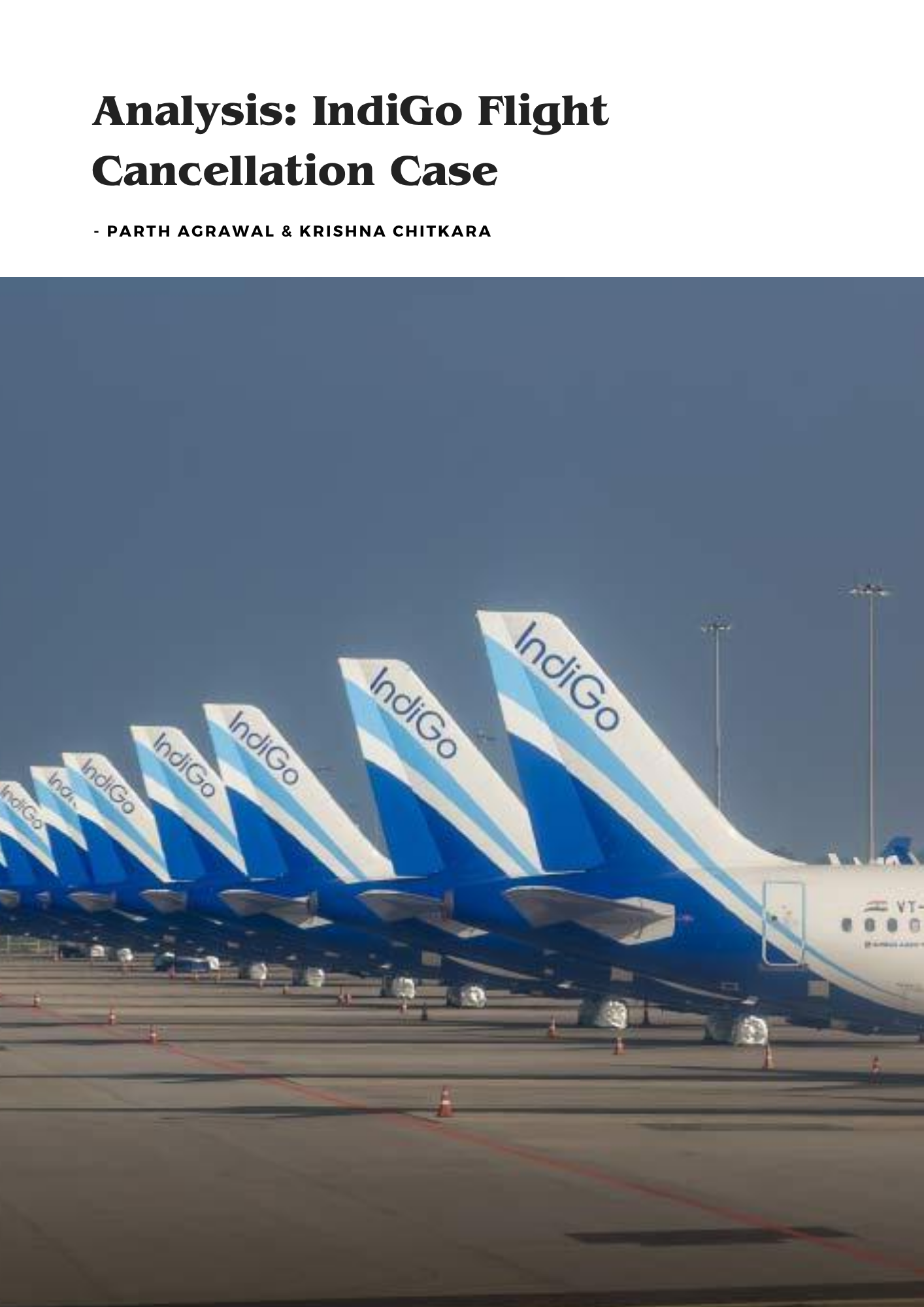
During December 2-December 8, 2025, IndiGo Airlines, India’s largest passenger carrier accounting for about 60% of the total domestic aviation capacities of India, cancelled more than 2,000 flights. These massive cancellations have left thousands of passengers stranded, forced the cancellation of urgent health treatments and important family commitments, and required immediate state intervention in the form of price control and alternative transport solutions. However, the immediate trigger of this disruption, which is the introduction of Phase II FDTL (Flight Duty Time Limitations) standards by DGCA from November 1, 2025, points to some other deep-rooted problems in the industry. First and foremost, this incident highlights the lack of planning and anticipation on the part of airlines after being informed about such regulations, two years ahead, as well as the vulnerability of such regulations to pressure from the industry itself. Additionally, poor measures for passenger safety and excessive concentration of systemic risks in one particular private airline were evident. After a detailed investigation of the operational malfunction, DGCA found out that the airline had not made appropriate adjustments regarding the manpower planning and flight scheduling in order to adjust to these new regulations. Therefore, the airline received a record fine of about $2.45 million (about ₹20 crore) from DGCA in January 2026. In this respect, the legal aspects relating to the case involve many facets, including corporate accountability, passenger rights, compliance regulations, and authority enforcement. The aim of this paper is to examine the law surrounding aviation regulation in India, identify the violations made by the airlines involved in the incident, and assess the consequences that it had on the relevant stakeholders and the industry as a whole. In order to develop an effective regulatory system for aviation in the future, all of these legal aspects must be considered in conjunction with safety, consumer protection, airline solvency, and competitiveness.
Dark Patterns vs. Executive Authority: Lessons from India's Aborted Airline Seat-Quota Directive
In March 2026, the Ministry of Civil Aviation directed the Directorate General of Civil Aviation (DGCA) to require all domestic airlines to make a minimum of 60% of seats on every flight available for selection at no additional charge, effective 20 April 2026. The directive was motivated by well-documented consumer complaints regarding deceptive digital booking practices, algorithmic seat separation, and the opaque presentation of ancillary charges by major Indian carriers. Within fourteen days and following coordinated opposition from the Federation of Indian Airlines (FIA), the Ministry suspended the seat-quota provision on 2 April 2026. This article analyses the regulatory episode across five interlocking legal frameworks: consumer protection and dark patterns; the statutory limits of DGCA authority under the Bharatiya Vayuyan Adhiniyam, 2024; the law of carriage; competition law; and administrative procedural fairness. A comparative analysis of the European Union and United States frameworks is also provided. The authors argue that while the directive was animated by legitimate objectives, it was legally vulnerable on authority grounds and procedurally deficient. A dedicated statutory Passenger Rights Act, transparency-based pricing mandates, sector-specific dark pattern enforcement, and mandatory stakeholder consultation offer a more durable path forward.